
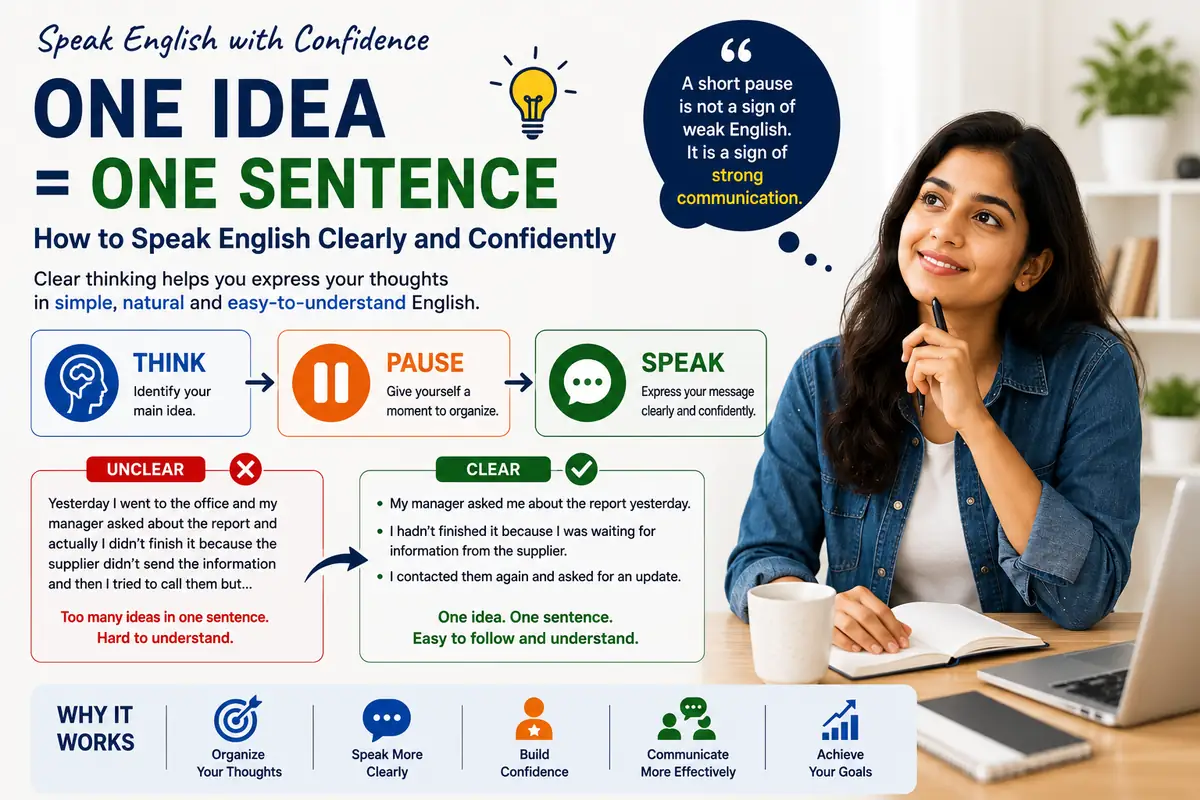
Have you ever started speaking in English and suddenly realized that your sentence had become too long? You know what you want to say. You know many of the words. You may even understand the grammar. But your sentence keeps going: “And… and… and…” Eventually, you lose your main idea. Sometimes, the person listening to you loses it too. This is something I often notice with English learners. They try to communicate several ideas in one sentence because they feel they need to keep speaking. But good communication doesn’t mean creating long sentences. It means making your message easy to understand. One simple principle can make a big difference: ONE IDEA = ONE SENTENCE Say one clear idea. Finish the sentence. Pause naturally. Then move to your next idea. It sounds simple—and that’s exactly why it works. Why Do We Make Long, Confusing Sentences in English? When you speak your first language, you usually don’t spend much time thinking about sentence structure. Your ideas and words come naturally. English can feel different. While speaking, you may be trying to do several things at the same time: That’s a lot for your brain to manage at once. As a result, many learners start a sentence before they have decided what the main idea is. The “And… And… And…” Habit Consider this example: “Yesterday my manager called me and he asked about the report and I told him it wasn’t finished and actually the supplier didn’t send the information and I tried to contact them and they didn’t answer…” The speaker has useful information. The English isn’t necessarily bad either. The problem is organization. There are several different ideas competing inside one sentence. What Is the Listener Trying to Understand? While you’re speaking, the listener is trying to identify your message. What happened? What is important? What do you want me to know? What should happen next? If you put too many ideas into one sentence, you make the listener work harder to find your message. Communication Is About the Listener Too Successful communication is not simply: “Did I speak English?” A better question is: “Did the other person understand what I wanted to say?” That small change in thinking can completely change the way you communicate. What Does “One Idea = One Sentence” Mean? The principle is very simple: One main idea → One clear sentence. Finish that idea before moving to the next one. Let’s return to our earlier example. Instead of: “Yesterday my manager called me and he asked about the report and I told him it wasn’t finished and actually the supplier didn’t send…” Try: “My manager asked me about the report yesterday. I told him it wasn’t finished. We were still waiting for information from the supplier. I contacted them again and asked for an update.” Notice the difference. The information is almost the same. But the second version is much easier to follow. Short Sentences Do Not Mean Poor English Some learners believe that advanced English means long sentences and difficult vocabulary. That isn’t necessarily true. Professional communication often depends on clarity. A short, well-organized sentence can be much more powerful than a long, complicated sentence. For example: “We can’t complete the project today because we’re still waiting for the client’s approval.” That’s simple English. But it’s also clear, natural and professional. Simple English Can Be Professional English You don’t need to impress people with complicated words in every conversation. Your first responsibility is to make your message understandable. Compare: “Due to certain circumstances relating to the information which has not yet been provided to us, we are currently unable to proceed with the completion.” with: “We can’t complete the work yet because we’re still waiting for the information.” In most everyday professional situations, the second version communicates the message more efficiently. Clear Is Better Than Complicated Remember: Simple does not mean uneducated. Short does not mean unprofessional. Clear does not mean basic. Clear communication is a skill. Start With the Main Idea Before creating your sentence, ask yourself: “What is the one thing I want this person to understand?” Don’t begin with grammar. Don’t begin by searching for impressive vocabulary. Begin with your idea. Idea First, English Second Suppose your manager asks: “Why is the order delayed?” Before answering, identify the main idea. Main idea: The supplier hasn’t delivered the materials. Now turn that idea into simple English: “The order is delayed because the supplier hasn’t delivered the materials yet.” That’s enough for your first sentence. If more information is necessary, add another sentence: “They have promised to deliver them tomorrow.” And perhaps another: “If we receive them on time, we can complete the order by Friday.” Now your response has a natural structure. Build Your Answer One Idea at a Time Think of communication like building with blocks. Idea 1 → Sentence 1 Idea 2 → Sentence 2 Idea 3 → Sentence 3 You don’t need to build the entire answer in your head before you start speaking. Give Each Idea Its Own Space When one idea is finished, stop. Allow a natural pause. Then continue. IDEA → SENTENCE → PAUSE → NEXT IDEA This gives both you and your listener time to process the conversation. How to Speak English Clearly in Real-Life Situations The One Idea = One Sentence method becomes especially useful when you’re under pressure. Let’s look at some common situations. At Work Your manager asks: “Can you give me an update?” Instead of: “Yes, actually we started yesterday and there was a problem with the system and IT checked it and now I think it’s working and we should finish…” Try: “We started the work yesterday. We had a system problem in the afternoon. IT has now fixed it. We expect to finish the work today.” Four ideas. Four clear sentences. During a Job Interview Question: “Why do you want this position?” You might have several ideas. Don’t try to communicate all of them at once. Start with your
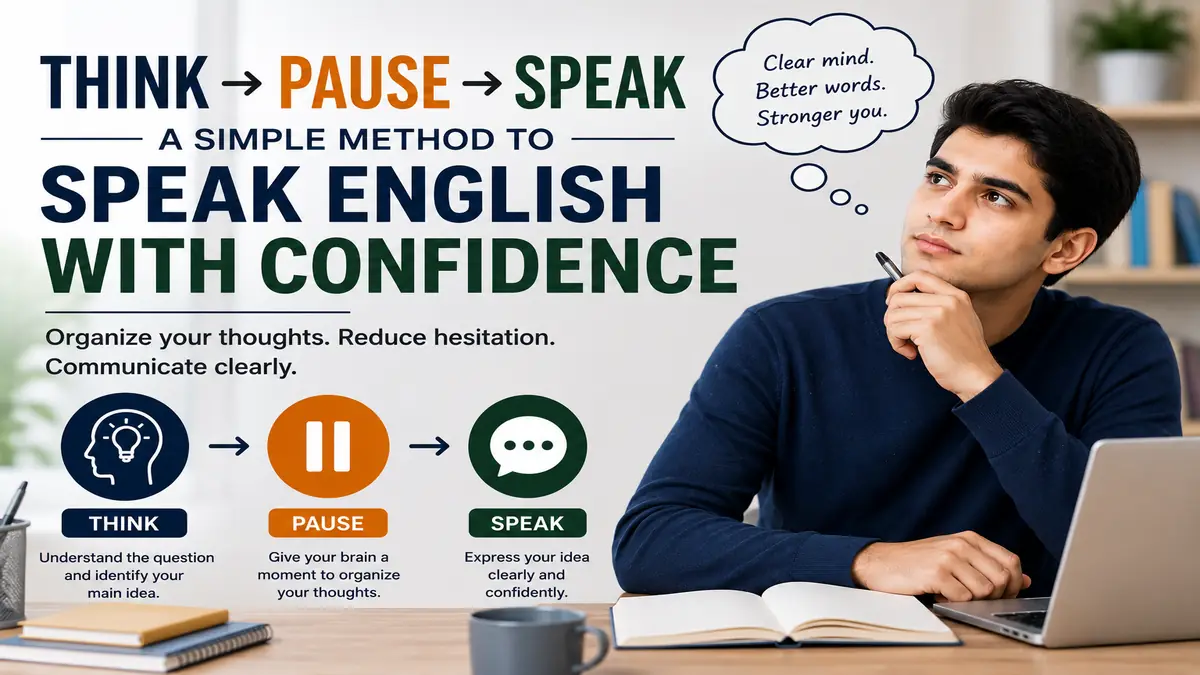
Think → Pause → Speak: A Simple Method to Speak English with Confidence
Do you sometimes know what you want to say in English, but when someone suddenly asks you a question, your mind goes blank? You may know the grammar. You may know the vocabulary. You may even know the answer. But you still hesitate. Why? One common reason is that you are putting too much pressure on yourself to answer immediately. Many English learners believe that confident speakers must respond quickly. As soon as someone asks a question, they try to speak before their thoughts are ready. This often creates more hesitation, not less. At OnlineEnglish.lk, we use a simple communication principle: THINK → PAUSE → SPEAK You don’t always need more English. Sometimes, you simply need to give your brain enough time to prepare the English you already know. Why Do English Learners Rush to Speak? Imagine someone asks you: “What do you do?” It sounds like a simple question. But inside your mind, several things may happen at the same time: “How should I start?” “Which tense should I use?” “Is this word correct?” “What if I make a mistake?” “Am I taking too long?” While you are worrying about all these things, you are also trying to answer. That creates unnecessary pressure. Your Brain Needs Time to Prepare Speaking is not just a mouth activity. Before you speak, your brain needs to understand the question, decide what you want to say, organize the idea, choose suitable English, and prepare the response. If you force yourself to speak before this process happens, your answer can become confused. A Better Communication Process Instead of: Question → Panic → Speak train yourself to use: Question → Think → Pause → Speak The Key Principle A short pause gives your brain time to turn an idea into a clear message. What Is the Think → Pause → Speak Method? Think → Pause → Speak is a simple communication technique designed to help English learners respond more clearly and confidently. It has three stages. Step 1: Think Before thinking about grammar, ask yourself: “What do I actually want to say?” Find your main idea first. Suppose someone asks: “Why do you want to improve your English?” Don’t immediately search for the perfect sentence. First identify the idea. Perhaps your idea is: I need English for my career. Now you have something clear to communicate. Step 2: Pause Give yourself a brief moment to organize the idea. You do not need to fill every second with words such as: “Actually…” “You know…” “I mean…” “So…so…” Silence for a moment is perfectly acceptable. A controlled pause can make you appear calmer and more thoughtful. Step 3: Speak Now express your idea using simple English. For example: “I want to improve my English because I need to communicate confidently at work.” The sentence doesn’t need complicated vocabulary. It needs a clear message. A Pause Is Not a Sign of Weak English Many learners are afraid of silence. They believe: “If I pause, the other person will think my English is poor.” That belief can create unnecessary pressure. Confident communicators pause too. Professionals pause during meetings. Speakers pause during presentations. Candidates pause during interviews. Managers pause before answering important questions. The difference is that they use the pause to think. Professional Pausing vs Hesitation There is an important difference between a controlled pause and nervous hesitation. A controlled pause is purposeful. You listen. You think. You organize. Then you answer. Nervous hesitation happens when you begin speaking without knowing where your sentence is going. Compare These Two Answers Question: “Can you give me an update on the project?” A rushed answer might sound like: “Yes, actually the project is… we are doing it and there are some things and I think maybe we can finish…” Now compare it with: Pause. “Yes. The project is progressing well. We have completed the first stage, and we expect to finish the remaining work by Friday.” The second speaker did not necessarily know more English. The speaker organized the message better. Remember A pause is not empty time. It is thinking time. Why Speaking Fast Does Not Mean Speaking Fluently Many English learners try to speak faster because they want to sound fluent. But speed and fluency are not the same thing. Speaking quickly with unclear ideas can make communication difficult. Speaking at a comfortable pace with clear ideas is usually more effective. What Real Fluency Looks Like Real fluency means being able to: Fluency is not a race. It is effective communication. Think About the Idea Before the Grammar This is one of the most important changes an English learner can make. Many students think: Grammar → Vocabulary → Sentence → Meaning Try reversing the process. Start with: Meaning → Idea → Simple English → Speak Example: Workplace Conversation Your manager asks: “Why was the report delayed?” Instead of immediately worrying about grammar, identify the main idea. Main idea: We were waiting for information from another department. Now speak: “The report was delayed because we were waiting for information from the finance team.” Clear idea. Simple sentence. Professional answer. One Main Idea Is Enough to Start Another common problem is trying to prepare the entire answer before saying anything. You don’t need to. Start with one clear idea. Then add another if necessary. Example: Job Interview Question: “Why are you interested in this position?” Your brain may create ten different ideas. Experience. Salary. Career development. Company reputation. New responsibilities. Future opportunities. Don’t try to say everything at once. Choose the strongest idea first. “I’m interested in this position because it matches my experience and gives me an opportunity to develop professionally.” Then pause. If more information is needed, continue. Use Think → Pause → Speak in Everyday Conversations This method isn’t only for classrooms. You can use it in real life. At Work Someone asks: “Can you finish this today?” Think. What is the real answer? Pause. Then respond: “I can complete most of it today, but I’ll need

Communication Starts in the Brain, Not in the Mouth
Have you ever wondered why some people speak English confidently while others hesitate, even though they know grammar and vocabulary? Many learners believe that speaking begins when they open their mouths. It doesn’t. Speaking begins much earlier. It begins in the brain. Before you say a single word, your brain has already understood the situation, created an idea, organized your thoughts, chosen the right words, and prepared your response. Your mouth simply delivers what your brain has already created. This is why learning to communicate is much more than learning grammar. If you want to become a confident English speaker, you must first train your brain. Speaking Is a Thinking Process Every conversation begins with a thought. When someone asks you a question, your brain immediately starts working. It doesn’t begin by remembering grammar rules. It begins by understanding the situation. Then it decides what you want to say. After that, it organizes your ideas and selects the words that best express your message. Finally, you speak. The better your thinking process, the easier speaking becomes. Communication Happens Before Words Many English learners spend years improving their pronunciation and grammar. Both are important. However, neither of them is where communication begins. Communication begins with understanding. Your brain first asks: Only after answering these questions does it create the sentence. If your ideas are clear, your words become clearer. If your ideas are confusing, your communication also becomes confusing. Many learners believe they have an English problem. In reality, they often have an idea organization problem. Clear thinking creates clear communication. How the Brain Creates Communication Before every sentence, your brain follows a natural process. It observes the situation. It understands what is happening. It creates an idea. It organizes that idea. It chooses suitable English. Finally, it speaks. This happens within seconds. Most people never notice this process because it happens automatically. However, when one part becomes difficult, speaking also becomes difficult. This is why communication is much more than vocabulary or grammar. Why Many English Learners Struggle Many students study English for years. They memorize grammar rules. They learn hundreds of vocabulary words. Some even memorize complete conversations. Yet, when someone asks a simple question, they hesitate. Why? Because no one has taught them how to organize their thoughts before speaking. Grammar cannot organize your ideas. Vocabulary cannot create your message. Communication begins with thinking. Without clear thinking, even perfect grammar cannot produce confident communication. Memorizing Is Not Communication Imagine you memorize one hundred interview answers. Now imagine the interviewer asks a completely different question. Most learners become silent. Not because they don’t know English. Because they don’t know how to create ideas in real time. Communication is not memorization. Communication is thinking. The more you practice creating ideas, the more naturally you communicate. The OnlineEnglish.lk Communication Framework At OnlineEnglish.lk, we believe communication begins before speaking. Our students learn a practical communication process instead of memorizing sentences. The process is simple. Observe → Think → Create Ideas → Organize Ideas → Choose English → Speak → The Listener Understands Every confident conversation follows this journey. Instead of worrying about grammar first, learners develop the ability to think clearly and communicate naturally. This is why our students become more confident in real-life conversations. Think Before You Speak Many professionals appear confident because they rarely speak immediately. They pause. They think. Then they speak. That short pause allows the brain to organize ideas. The result is clear, confident communication. This is the foundation of our Think → Pause → Speak method. Speaking quickly does not make you fluent. Speaking clearly makes you effective. Five Practical Ways to Train Your Brain Improving communication starts with changing your daily habits. Observe More Before speaking, take a moment to understand the situation. Good communication always begins with observation. Think About One Main Idea Ask yourself: “What is the one message I want to communicate?” When your message is clear, speaking becomes much easier. Organize Your Thoughts Don’t try to say everything at once. Start with your main idea. Then add one or two supporting details. This simple structure makes your communication easier to understand. Use Simple English Many learners believe they need difficult vocabulary. They don’t. Simple English used confidently is always more powerful than complicated English spoken with hesitation. Professional communication is about clarity, not complexity. Practice Every Day Communication improves through regular practice. Spend a few minutes every day describing your surroundings, explaining your thoughts, or speaking about your daily activities in English. Small improvements every day create lasting confidence. Common Mistakes That Slow Your Communication Many learners unknowingly create unnecessary obstacles. Some focus only on grammar. Others translate every sentence. Some memorize conversations. Many try to speak too quickly because they think speed means fluency. None of these habits develops confident communication. Instead, focus on understanding, thinking, organizing ideas, and expressing them naturally. Why Our Teaching Method Is Different At OnlineEnglish.lk, we don’t simply teach English. We teach communication. Our goal is to help learners think clearly before they speak. Our students learn to: We believe that grammar supports communication. It does not create communication. Frequently Asked Questions Does communication really begin in the brain? Yes. Before you speak, your brain must understand the situation, create an idea, organize your thoughts, and choose appropriate words. Speaking is simply the final step. Should I stop learning grammar? No. Grammar is important. However, grammar should support your communication rather than become your only focus. How can I improve my communication skills? Practice observing situations, thinking clearly, organizing your ideas, and speaking regularly. The more you train your brain, the more naturally your English will develop. Final Thoughts Many people believe communication begins when they start speaking. In reality, communication begins much earlier. It begins in the brain. When you learn to observe, think clearly, organize your ideas, and express them naturally, speaking becomes easier, more confident, and more effective. Remember the OnlineEnglish.lk philosophy: Communication Starts in the Brain, Not in the Mouth.

Stop Translating. Start Thinking in English.
Many English learners believe grammar is the biggest obstacle to speaking English. In reality, the biggest obstacle is translation. If you translate every thought before you speak, your conversations become slow, stressful, and unnatural. Learning to think directly in English is one of the most effective ways to improve your spoken English and build lasting confidence. Why Do We Translate Before Speaking? When learning English, most people first think in their native language and then translate their thoughts into English. This feels natural because it is how they have learned English throughout school. Unfortunately, real conversations do not give you enough time to translate every sentence. By the time you finish translating, the conversation has already moved on. Translation creates hesitation, uncertainty, and a lack of confidence. Translation Is a Habit, Not a Language Problem Most learners assume they need more vocabulary or more grammar. However, many people already know enough English to communicate. The real issue is that they have developed the habit of translating every thought before speaking. Breaking this habit is often more valuable than memorizing another grammar rule. Why Translation Slows Your Brain Every translated sentence follows a longer thinking process. The Translation Process Idea ↓ Native Language ↓ Translation ↓ English ↓ Speaking Every additional step increases the time required to respond. Natural speakers remove the translation step completely. Why Thinking in English Improves Fluency Speaking becomes easier when your brain connects ideas directly with English. Instead of translating words, you begin expressing thoughts naturally. This creates smoother conversations and faster responses. Thinking in English also helps you become a better listener because your brain is no longer busy translating every sentence. The Benefits of Thinking in English When you think directly in English, you will gradually notice: Fluency is not about speaking quickly. Fluency is about expressing ideas naturally. Communication Starts in the Brain At OnlineEnglish.lk, we teach that communication begins before you speak. Every sentence follows a thinking process. The OnlineEnglish.lk Communication Framework Observe the situation. ↓ Create an idea. ↓ Organize your thoughts. ↓ Choose simple English. ↓ Speak clearly. ↓ The listener understands your message. Notice that grammar is only one small part of this process. Thinking comes first. Communication comes next. Grammar supports both. Why This Method Works Many learners spend years learning grammar. Very few spend time learning how to organize ideas before speaking. When your thinking becomes clear, your English also becomes clear. Remember This Communication starts in the brain—not in the mouth. Five Practical Ways to Start Thinking in English Changing the way you think takes practice. Fortunately, you can begin today. Describe Your Surroundings Look around you. Describe what you see using simple English. Don’t worry about perfect grammar. Focus on creating ideas. Example: “The office is quiet.” “My laptop is on the desk.” “It’s raining outside.” Narrate Your Daily Activities Describe your actions throughout the day. Examples: “I’m making breakfast.” “I’m replying to emails.” “I’m driving to work.” Simple thoughts help your brain connect everyday situations with English. Ask Yourself Questions Create small conversations inside your mind. Examples: What should I do today? What is my next meeting? How do I feel today? Answer each question in English. Learn Ideas Instead of Individual Words Instead of memorizing vocabulary lists, learn complete ideas. Example: “We’re discussing the project during today’s meeting.” Your brain remembers meaningful situations better than isolated words Practice Every Day Consistency is more important than intensity. Even ten minutes of daily thinking in English will produce better results than several hours once a week. Common Mistakes to Avoid Many learners unknowingly slow their progress. Waiting for Perfect Grammar Perfection delays communication. Speak first. Improve continuously. Memorizing Entire Conversations Real conversations are unpredictable. Instead of memorizing answers, learn how to create your own. Fear of Making Mistakes Mistakes are part of learning. Every conversation helps you improve. Confidence grows through practice. How OnlineEnglish.lk Helps You Think in English Our communication training goes beyond grammar. We help learners develop the ability to think, organize ideas, and communicate naturally. Our students learn to: Our philosophy is simple. Express Your Thoughts in English. Frequently Asked Questions Should I stop translating completely? Translation is useful when learning new vocabulary. However, during conversations, relying on translation slows your thinking and reduces fluency How long does it take to think in English? Every learner is different. With regular daily practice, many people begin noticing improvements within a few weeks. Do I need perfect grammar before speaking? No. Grammar supports communication. It does not create communication. The best way to improve is through real speaking practice. Final Thoughts Many English learners believe they need more grammar before they can speak confidently. In reality, they need a better thinking process. The moment you stop translating every sentence and begin thinking directly in English, communication becomes faster, clearer, and more natural. Remember the OnlineEnglish.lk philosophy: Think Clearly. Organize Your Ideas. Express Your Thoughts in English. Speaking English is not about translating words. It is about communicating ideas with confidence.

Why Can’t I Speak English Even Though I Know Grammar?
Have you ever said, “I know English grammar, but I still can’t speak English confidently.” If your answer is yes, you are not alone. Many adults and professionals in Sri Lanka face the same problem. They studied English for years, passed school exams, and know many grammar rules. Yet, when they need to speak in a meeting, attend an interview, or have a simple conversation, they struggle to express themselves. The good news is that the problem is not your grammar. The real problem is that speaking English is a communication skill, not just a grammar skill. Grammar Helps You Build Sentences, But It Doesn’t Build Confidence Grammar is important because it helps you create correct sentences. However, grammar alone cannot make you a confident speaker. Think of grammar as the rules of driving a car. You can read every driving rule and pass the written test, but that doesn’t mean you can drive confidently on a busy road. To become a good driver, you need practice. Speaking English works the same way. You need to think, organize your ideas, choose the right words, and speak naturally. Grammar supports this process, but it does not create it. Why Many People Feel Stuck Many learners spend years memorizing grammar rules, vocabulary lists, and model answers. They become very good at answering written questions. However, real conversations are different. People do not give you time to remember grammar rules before you speak. They expect you to understand, think, and respond naturally. Memorizing Is Different from Communicating When you memorize English, you are preparing for an exam. When you communicate, you are sharing your thoughts with another person. These are two completely different skills. Real Communication Is About Sharing Ideas The goal of communication is not to impress people with difficult English. The goal is to help the other person understand your message clearly. The Real Reason You Can’t Speak English Speaking starts in your brain, not in your mouth. Before you speak, your brain performs several steps in just a few seconds. If your brain is not trained to organize ideas quickly, speaking becomes difficult, even if your grammar is good. The Translation Habit Many learners first think in Sinhala or Tamil. Then they translate every sentence into English. This slows down the entire speaking process. While you are translating, the conversation continues. By the time you find the correct words, the opportunity to speak has already passed. Why Translation Reduces Confidence When translation becomes a habit, your brain works harder than necessary. You become slower, hesitate more, and worry about making mistakes. This creates stress and reduces your confidence. Think Directly in English Instead of translating every sentence, start thinking in simple English. Even short thoughts like “I’m hungry,” “I need help,” or “Let’s begin” help train your brain to think naturally in English. Confidence Comes Before Perfection One of the biggest mistakes learners make is waiting until their English is perfect before they speak. Unfortunately, that day never comes. Confidence grows through speaking, making mistakes, learning, and trying again. Every conversation helps you improve. Remember: You do not become confident before speaking. You become confident by speaking. Don’t Be Afraid of Mistakes Everyone makes mistakes while learning a language. Even native speakers make mistakes. The important thing is that people understand your message. Communication is always more important than perfection. A Simple Way to Speak More Clearly At OnlineEnglish.lk, we teach students to organize their ideas before they speak. One simple method is: This makes your English sound clearer, calmer, and more confident. Think → Pause → Speak Instead of speaking immediately, This small habit makes a big difference. One Idea → One Sentence Don’t try to say everything at once. Express one complete idea. Then move to the next idea. This helps both you and your listener. How OnlineEnglish.lk Helps You Speak Naturally At OnlineEnglish.lk, we believe that English is a communication tool—not a grammar test. Our students learn how to: Our goal is simple: Help you express your thoughts in English with confidence, clarity, and ease. Frequently Asked Questions Why do I know grammar but still can’t speak English? Because speaking requires more than grammar. It requires thinking, organizing ideas, vocabulary, confidence, listening, and regular speaking practice. Should I stop learning grammar? No. Grammar is important, but it should support your communication, not become your only focus. How can I become a confident English speaker? Practice speaking regularly, think directly in English, organize your ideas before speaking, and communicate in real-life situations. Final Thoughts If you know grammar but still struggle to speak English, don’t be discouraged. The problem is not your ability. The problem is how you learned English. When you stop focusing only on grammar and start focusing on communication, everything begins to change. Remember the OnlineEnglish.lk philosophy: Communication starts in the brain, not in the mouth. Train your brain to think clearly, organize your ideas, and express yourself naturally. That is how confident English speaking begins.