
Have you ever started speaking in English and suddenly realized that your sentence had become too long?
You know what you want to say. You know many of the words. You may even understand the grammar.
But your sentence keeps going:
“And… and… and…”
Eventually, you lose your main idea. Sometimes, the person listening to you loses it too.
This is something I often notice with English learners. They try to communicate several ideas in one sentence because they feel they need to keep speaking.
But good communication doesn’t mean creating long sentences.
It means making your message easy to understand.
One simple principle can make a big difference:
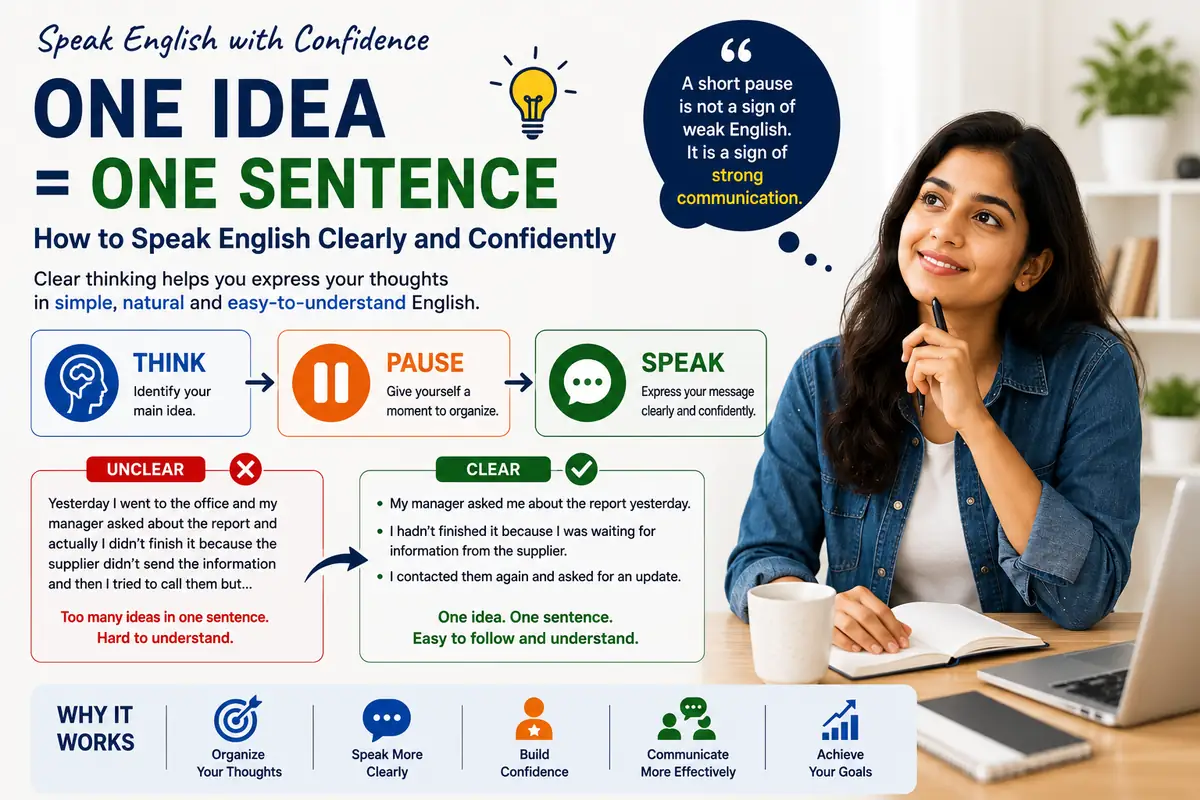
ONE IDEA = ONE SENTENCE
Say one clear idea. Finish the sentence. Pause naturally. Then move to your next idea.
It sounds simple—and that’s exactly why it works.
Why Do We Make Long, Confusing Sentences in English?
When you speak your first language, you usually don’t spend much time thinking about sentence structure. Your ideas and words come naturally.
English can feel different.
While speaking, you may be trying to do several things at the same time:
- Think about your message
- Remember vocabulary
- Check your grammar
- Translate from your first language
- Think about pronunciation
- Watch the listener’s reaction
- Decide what to say next
That’s a lot for your brain to manage at once.
As a result, many learners start a sentence before they have decided what the main idea is.
The “And… And… And…” Habit
Consider this example:
“Yesterday my manager called me and he asked about the report and I told him it wasn’t finished and actually the supplier didn’t send the information and I tried to contact them and they didn’t answer…”
The speaker has useful information.
The English isn’t necessarily bad either.
The problem is organization.
There are several different ideas competing inside one sentence.
What Is the Listener Trying to Understand?
While you’re speaking, the listener is trying to identify your message.
What happened?
What is important?
What do you want me to know?
What should happen next?
If you put too many ideas into one sentence, you make the listener work harder to find your message.
Communication Is About the Listener Too
Successful communication is not simply:
“Did I speak English?”
A better question is:
“Did the other person understand what I wanted to say?”
That small change in thinking can completely change the way you communicate.
What Does “One Idea = One Sentence” Mean?
The principle is very simple:
One main idea → One clear sentence.
Finish that idea before moving to the next one.
Let’s return to our earlier example.
Instead of:
“Yesterday my manager called me and he asked about the report and I told him it wasn’t finished and actually the supplier didn’t send…”
Try:
“My manager asked me about the report yesterday. I told him it wasn’t finished. We were still waiting for information from the supplier. I contacted them again and asked for an update.”
Notice the difference.
The information is almost the same.
But the second version is much easier to follow.
Short Sentences Do Not Mean Poor English
Some learners believe that advanced English means long sentences and difficult vocabulary.
That isn’t necessarily true.
Professional communication often depends on clarity.
A short, well-organized sentence can be much more powerful than a long, complicated sentence.
For example:
“We can’t complete the project today because we’re still waiting for the client’s approval.”
That’s simple English.
But it’s also clear, natural and professional.
Simple English Can Be Professional English
You don’t need to impress people with complicated words in every conversation.
Your first responsibility is to make your message understandable.
Compare:
“Due to certain circumstances relating to the information which has not yet been provided to us, we are currently unable to proceed with the completion.”
with:
“We can’t complete the work yet because we’re still waiting for the information.”
In most everyday professional situations, the second version communicates the message more efficiently.
Clear Is Better Than Complicated
Remember:
Simple does not mean uneducated.
Short does not mean unprofessional.
Clear does not mean basic.
Clear communication is a skill.
Start With the Main Idea
Before creating your sentence, ask yourself:
“What is the one thing I want this person to understand?”
Don’t begin with grammar.
Don’t begin by searching for impressive vocabulary.
Begin with your idea.
Idea First, English Second
Suppose your manager asks:
“Why is the order delayed?”
Before answering, identify the main idea.
Main idea: The supplier hasn’t delivered the materials.
Now turn that idea into simple English:
“The order is delayed because the supplier hasn’t delivered the materials yet.”
That’s enough for your first sentence.
If more information is necessary, add another sentence:
“They have promised to deliver them tomorrow.”
And perhaps another:
“If we receive them on time, we can complete the order by Friday.”
Now your response has a natural structure.
Build Your Answer One Idea at a Time
Think of communication like building with blocks.
Idea 1 → Sentence 1
Idea 2 → Sentence 2
Idea 3 → Sentence 3
You don’t need to build the entire answer in your head before you start speaking.
Give Each Idea Its Own Space
When one idea is finished, stop.
Allow a natural pause.
Then continue.
IDEA → SENTENCE → PAUSE → NEXT IDEA
This gives both you and your listener time to process the conversation.
How to Speak English Clearly in Real-Life Situations
The One Idea = One Sentence method becomes especially useful when you’re under pressure.
Let’s look at some common situations.
At Work
Your manager asks:
“Can you give me an update?”
Instead of:
“Yes, actually we started yesterday and there was a problem with the system and IT checked it and now I think it’s working and we should finish…”
Try:
“We started the work yesterday. We had a system problem in the afternoon. IT has now fixed it. We expect to finish the work today.”
Four ideas.
Four clear sentences.
During a Job Interview
Question: “Why do you want this position?”
You might have several ideas.
Don’t try to communicate all of them at once.
Start with your strongest one:
“This position matches my professional experience.”
Pause.
Then add:
“It also gives me an opportunity to develop my management skills.”
Pause.
Then:
“I believe I can contribute positively to the team.”
Notice the Structure
Each sentence has a purpose:
Experience → Development → Contribution
The listener doesn’t have to search for your meaning.
Use the Method in Meetings and Presentations
Clear sentence structure becomes even more important when you’re communicating professionally.
During a meeting, people need to understand your point quickly.
Don’t Speak Just to Fill the Silence
Some learners become uncomfortable when there is a short silence.
So they continue speaking.
This creates filler words:
“Actually… and… so… you know… basically… and then…”
You don’t have to fill every second.
Finish your sentence.
Pause.
Think.
Continue.
Combine It With Think → Pause → Speak
This method works naturally with another useful communication principle:
THINK → PAUSE → SPEAK
First, think about your idea.
Then pause briefly.
Speak one clear sentence.
Finish it.
Then move to your next idea.
The Full Communication Pattern
Practice this sequence:
THINK → MAIN IDEA → ONE SENTENCE → PAUSE → NEXT IDEA
This gives your speaking structure without making it sound memorized.
How to Practice One Idea = One Sentence
You can practice this every day without spending hours studying.
Start with situations from your own life.
The Three-Sentence Exercise
Choose one simple topic.
For example:
“What did I do today?”
Now answer using only three sentences:
“I had a busy morning at work.”
“I attended two meetings.”
“I finished an important report in the afternoon.”
Three ideas.
Three sentences.
That’s enough.
Practice With Questions You Actually Hear
Don’t only practice textbook questions.
Use questions from your real life:
- What happened?
- What do you think?
- Why was it delayed?
- What are you doing tomorrow?
- How was your weekend?
- What do you recommend?
- Why do you want this job?
Answer each question using short, complete ideas.
Record Yourself
Use your phone and record a one-minute answer.
Then listen to yourself.
Don’t only ask:
“Was my grammar correct?”
Also ask:
“Did I have one clear idea in each sentence?”
“Did I use ‘and’ too many times?”
“Did I finish my sentences?”
“Was my main message easy to understand?”
These questions help you develop communication skills, not just English knowledge.
Don’t Try to Make Every Sentence Perfect
There is another important point.
If you become obsessed with making every sentence perfect, you may create a new problem.
You may become afraid to speak.
The goal of this method isn’t perfection.
The goal is clarity.
Communication Before Perfection
Imagine you say:
“I sent the document yesterday, but I haven’t received a reply yet.”
Perhaps there is another, more sophisticated way to say it.
It doesn’t matter.
Your listener understood you.
Communication happened.
That’s success.
Improve After You Can Communicate
As your confidence develops, you can improve your grammar, vocabulary, pronunciation and sentence variety.
But first, develop the ability to express a clear thought.
Build From Simple to Strong
Start with:
Clear Idea → Simple Sentence
Then develop:
Clear Idea → Natural Sentence → Better Vocabulary → Stronger Communication
Don’t reverse the process.
Why This Method Builds Speaking Confidence
Confidence grows when you feel that you can control your message.
If you start a long sentence without knowing where it is going, you may feel lost.
But when you focus on one idea at a time, speaking becomes more manageable.
Your Brain Has Less Work to Do
You don’t need to prepare five ideas simultaneously.
You only need to answer one question:
“What do I want to say now?”
Create that sentence.
Say it.
Then move forward.
Your Listener Understands You More Easily
When people understand you, conversations become easier.
They respond naturally.
You feel more comfortable.
You become more willing to speak.
That creates a positive cycle:
Clear Thinking → Clear Speaking → Better Understanding → More Confidence
Confidence Comes From Successful Communication
You don’t need to wait until your English is perfect before becoming confident.
Confidence can grow every time you successfully express an idea and another person understands you.
One Idea = One Sentence Is a Communication Habit
You don’t need to memorize hundreds of rules to start using this method.
You need to develop a habit.
When you notice yourself creating a very long sentence, don’t panic.
Finish your current idea.
Pause.
Then start a new sentence.
What Should You Remember?
When speaking English:
Don’t rush.
Don’t put everything into one sentence.
Don’t worry about sounding sophisticated.
Instead:
Find your main idea.
Express it clearly.
Finish the sentence.
Pause.
Move to the next idea.
A Simple Formula for Clear English
Use this whenever you feel your speaking becoming confused:
ONE IDEA → ONE SENTENCE → PAUSE → NEXT IDEA
Your Goal Is Understanding
The purpose of communication isn’t to show people how many English words you know.
It’s to help another person understand what you think, feel, need, know or want to communicate.
Final Thoughts: Speak Less, Communicate More
Speaking English clearly doesn’t always require more vocabulary, more grammar or longer sentences.
Sometimes, improvement comes from doing something simpler:
Organize your thoughts.
When you have one idea, give that idea one clear sentence.
Finish it.
Pause.
Then continue.
The next time you find yourself saying:
“and… and… and…”
remember:
ONE IDEA = ONE SENTENCE
You may be surprised by how much calmer, clearer and more confident your English becomes.
At OnlineEnglish.lk, we believe good English communication begins with clear thinking.
Think clearly. Organize your ideas. Speak with confidence.