
Do you sometimes know what you want to say in English, but when someone suddenly asks you a question, your mind goes blank?
You may know the grammar.
You may know the vocabulary.
You may even know the answer.
But you still hesitate.
Why?
One common reason is that you are putting too much pressure on yourself to answer immediately.
Many English learners believe that confident speakers must respond quickly. As soon as someone asks a question, they try to speak before their thoughts are ready.
This often creates more hesitation, not less.
At OnlineEnglish.lk, we use a simple communication principle:
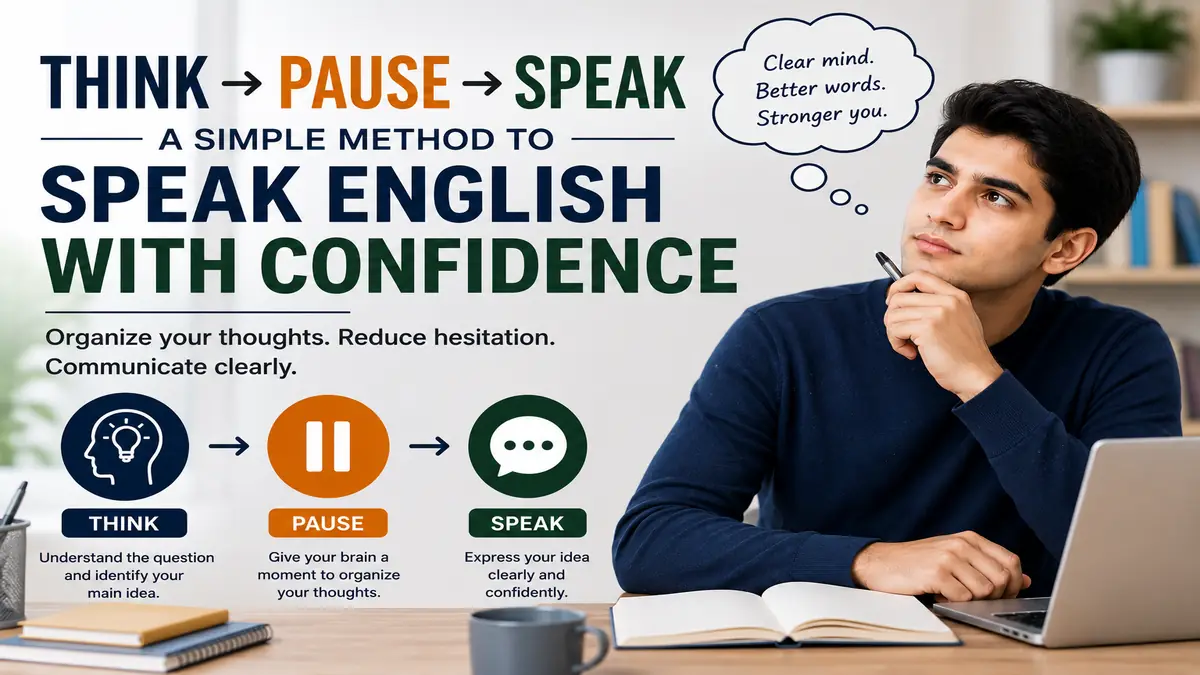
THINK → PAUSE → SPEAK
You don’t always need more English.
Sometimes, you simply need to give your brain enough time to prepare the English you already know.
Why Do English Learners Rush to Speak?
Imagine someone asks you:
“What do you do?”
It sounds like a simple question.
But inside your mind, several things may happen at the same time:
“How should I start?”
“Which tense should I use?”
“Is this word correct?”
“What if I make a mistake?”
“Am I taking too long?”
While you are worrying about all these things, you are also trying to answer.
That creates unnecessary pressure.
Your Brain Needs Time to Prepare
Speaking is not just a mouth activity.
Before you speak, your brain needs to understand the question, decide what you want to say, organize the idea, choose suitable English, and prepare the response.
If you force yourself to speak before this process happens, your answer can become confused.
A Better Communication Process
Instead of:
Question → Panic → Speak
train yourself to use:
Question → Think → Pause → Speak
The Key Principle
A short pause gives your brain time to turn an idea into a clear message.
What Is the Think → Pause → Speak Method?
Think → Pause → Speak is a simple communication technique designed to help English learners respond more clearly and confidently.
It has three stages.
Step 1: Think
Before thinking about grammar, ask yourself:
“What do I actually want to say?”
Find your main idea first.
Suppose someone asks:
“Why do you want to improve your English?”
Don’t immediately search for the perfect sentence.
First identify the idea.
Perhaps your idea is:
I need English for my career.
Now you have something clear to communicate.
Step 2: Pause
Give yourself a brief moment to organize the idea.
You do not need to fill every second with words such as:
“Actually…”
“You know…”
“I mean…”
“So…so…”
Silence for a moment is perfectly acceptable.
A controlled pause can make you appear calmer and more thoughtful.
Step 3: Speak
Now express your idea using simple English.
For example:
“I want to improve my English because I need to communicate confidently at work.”
The sentence doesn’t need complicated vocabulary.
It needs a clear message.
A Pause Is Not a Sign of Weak English
Many learners are afraid of silence.
They believe:
“If I pause, the other person will think my English is poor.”
That belief can create unnecessary pressure.
Confident communicators pause too.
Professionals pause during meetings.
Speakers pause during presentations.
Candidates pause during interviews.
Managers pause before answering important questions.
The difference is that they use the pause to think.
Professional Pausing vs Hesitation
There is an important difference between a controlled pause and nervous hesitation.
A controlled pause is purposeful.
You listen.
You think.
You organize.
Then you answer.
Nervous hesitation happens when you begin speaking without knowing where your sentence is going.
Compare These Two Answers
Question: “Can you give me an update on the project?”
A rushed answer might sound like:
“Yes, actually the project is… we are doing it and there are some things and I think maybe we can finish…”
Now compare it with:
Pause.
“Yes. The project is progressing well. We have completed the first stage, and we expect to finish the remaining work by Friday.”
The second speaker did not necessarily know more English.
The speaker organized the message better.
Remember
A pause is not empty time. It is thinking time.
Why Speaking Fast Does Not Mean Speaking Fluently
Many English learners try to speak faster because they want to sound fluent.
But speed and fluency are not the same thing.
Speaking quickly with unclear ideas can make communication difficult.
Speaking at a comfortable pace with clear ideas is usually more effective.
What Real Fluency Looks Like
Real fluency means being able to:
- Understand what is being said.
- Create an appropriate response.
- Organize your thoughts.
- Express your message clearly.
- Continue the conversation naturally.
Fluency is not a race.
It is effective communication.
Think About the Idea Before the Grammar
This is one of the most important changes an English learner can make.
Many students think:
Grammar → Vocabulary → Sentence → Meaning
Try reversing the process.
Start with:
Meaning → Idea → Simple English → Speak
Example: Workplace Conversation
Your manager asks:
“Why was the report delayed?”
Instead of immediately worrying about grammar, identify the main idea.
Main idea: We were waiting for information from another department.
Now speak:
“The report was delayed because we were waiting for information from the finance team.”
Clear idea.
Simple sentence.
Professional answer.
One Main Idea Is Enough to Start
Another common problem is trying to prepare the entire answer before saying anything.
You don’t need to.
Start with one clear idea.
Then add another if necessary.
Example: Job Interview
Question: “Why are you interested in this position?”
Your brain may create ten different ideas.
Experience.
Salary.
Career development.
Company reputation.
New responsibilities.
Future opportunities.
Don’t try to say everything at once.
Choose the strongest idea first.
“I’m interested in this position because it matches my experience and gives me an opportunity to develop professionally.”
Then pause.
If more information is needed, continue.
Use Think → Pause → Speak in Everyday Conversations
This method isn’t only for classrooms.
You can use it in real life.
At Work
Someone asks:
“Can you finish this today?”
Think.
What is the real answer?
Pause.
Then respond:
“I can complete most of it today, but I’ll need until tomorrow morning to finish the final section.”
During an Interview
The interviewer asks:
“Tell me about yourself.”
Don’t rush into your life story.
Think about what is relevant.
Pause.
Then begin:
“I’m an IT professional with five years of experience in technical support and system administration.”
During a Meeting
Someone asks:
“What do you think about this proposal?”
You don’t have to answer instantly.
Pause briefly.
Then say:
“I think the overall idea is good, but we should consider the implementation cost before making a final decision.”
How to Practice Think → Pause → Speak Every Day
You don’t need a classroom to practice this technique.
You can train yourself for a few minutes every day.
Practice With Simple Questions
Ask yourself questions such as:
What did I do today?
What am I working on?
What is my plan for tomorrow?
What problem did I solve today?
Don’t answer immediately.
Think.
Pause.
Speak.
Practice With Professional Questions
If you use English at work, practice questions such as:
Can you explain this problem?
What do you recommend?
Why did this happen?
What should we do next?
Again:
Think → Pause → Speak
Record Yourself
Record a one-minute answer on your phone.
Listen to it.
Don’t only check your grammar.
Ask yourself:
Was my main idea clear?
Did I organize my answer?
Did I rush?
Did I use unnecessary words?
Could the listener understand me easily?
This develops communication awareness.
Common Mistakes to Avoid
When practicing this method, avoid turning it into another complicated rule.
You don’t need to count seconds before every answer.
You don’t need to prepare perfect sentences.
And you don’t need to eliminate every hesitation.
The purpose is simple:
Give your brain enough space to create a clear message.
Don’t Translate During the Pause
The pause should not become:
Native language → Translate → Check grammar → Speak
Instead, try:
Idea → Simple English → Speak
This connects naturally with another important OnlineEnglish.lk principle:
Stop Translating. Start Thinking in English.
How Think → Pause → Speak Builds Confidence
Confidence doesn’t always come before speaking.
Often, confidence develops because you repeatedly experience successful communication.
You understand a question.
You organize an answer.
You communicate it.
The listener understands you.
Your brain learns:
“I can do this.”
Then the next conversation becomes easier.
Confidence Comes From Control
When you rush, you may feel that English controls you.
When you learn to pause and organize your thoughts, you begin controlling the conversation.
That feeling of control helps build confidence.
Clear Thinking Creates Clear Speaking
The goal is not to impress people with difficult English.
The goal is to make your message easy to understand.
The OnlineEnglish.lk Principle
Think clearly. Pause naturally. Speak confidently.
Frequently Asked Questions
Will pausing make me sound less fluent?
No. Natural speakers pause regularly.
A short, purposeful pause can make your communication sound calmer and more considered.
How long should I pause?
Usually, you only need a brief moment.
The purpose is not to create a long silence. It is to give yourself enough time to identify and organize your main idea.
Should I think about grammar before speaking?
Grammar is important, but don’t allow grammar checking to dominate every conversation.
Think about your message first and use the English you already know to communicate it clearly.
Can I use this method in job interviews?
Yes.
It can be particularly useful in interviews because thoughtful answers are usually more effective than rushed ones.
Listen carefully to the question, identify your main point, pause briefly, and then answer.
Can beginners use Think → Pause → Speak?
Absolutely.
In fact, beginners can benefit greatly from it because it encourages them to use short, manageable ideas instead of trying to create complicated sentences.
Final Thoughts
You don’t have to answer every question immediately.
And you don’t have to speak quickly to prove that you are fluent.
Give yourself permission to think.
Give your brain a moment to organize your idea.
Then speak.
The next time someone asks you a question in English, remember three simple steps:
THINK → PAUSE → SPEAK
Think about your message.
Pause to organize it.
Speak clearly and confidently.
At OnlineEnglish.lk, we believe confident communication begins with clear thinking.
Think clearly. Organize your ideas. Express your thoughts in English.